For Artemis Ward
US brands have a lot to learn from K-pop
2024.10.25
/
Articles
In the summer of 2012, 80,000 people crowded onto the grassy lawn of Seoul’s City Hall Plaza for a free concert held by South Korean singer and rapper Psy. The concert marked his triumphant return home after the unexpected yet remarkable global success of “Gangnam Style” — the first YouTube video to reach a billion streams (just over a decade later, it’s amassed 5.3 billion views). For Psy, a veteran artist with a decades-long career in Korea, this free concert was more than a celebration; it was a gesture of gratitude to the fans who had supported him long before his viral breakthrough.
The success of “Gangnam Style” was pivotal not only for Psy, who went on to become the face of Korean Tourism the following year, but also for the entire K-pop industry. You might not know this: K-pop is just one piece of South Korea’s larger cultural export strategy — a deliberate “soft power” national rebranding effort launched after the 1997 Asian financial crisis. Known as the Hallyu Wave (or Korean Wave), this effort extends far beyond music, encompassing everything from cinema to cuisine. (Recent global successes like Squid Game and Parasite aren’t isolated phenomena; they’re the latest fruits of Korea’s long-term cultural investment.)
Throughout the ’90s and early 2000s, many Korean stars attempted to break into the U.S. market through traditional means, vying for roles in blockbuster movies and guest appearances on late-night TV — and, arguably, they failed. But, after Psy’s breakout success, Korean executives gained confidence that they no longer needed to seek out expensive media placements or watch their best celebrities waste time starring in terrible movies. Instead, they realized that building a dedicated fan base, or “fandom,” through social content could pave the way to blockbuster milestones naturally (just take a look at the 2018 Billboard Awards.)
Today, K-pop groups like BTS command global attention, elevating fan engagement into an art form through sophisticated ecosystems that transform casual interest into fierce brand loyalty, particularly among Gen Z. The band’s strategy, as its creator Bang Si-hyuk puts it, is “trying to figure out the most fandom-friendly thing to do and then taking it to the extreme.” It’s not about producing on-trend content (in this day and age, that’s a given). Instead, it’s about crafting content that directly responds to and communicates with fans, making them feel like they’re co-creators who have a say in their favorite band’s journey.

But what makes a strategy fandom-friendly, exactly? It starts with reimagining what it means to be an “insider,” offering audiences a front-row seat not only to the finished product, but also to the entire process. Take Katseye, a new multicultural girl group created by Si-hyuk, whose discovery and formation was chronicled in real-time through the Netflix documentary Pop Star Academy. The “discovery” of rising stars is typically a thinly veiled mystery, with stars like Olivia Rodrigo seeming to blow up overnight (with the exception, perhaps, of British boy band One Direction, who were created on The X-Factor by Nicole Scherzinger and Simon Cowell). By contrast, fans were invited to be part of Katseye’s origin story, watching each step unfold during the Netflix competition series, which narrowed over 120,000 applicants into six soon-to-be stars.
In the K-pop model, fandom isn’t left to chance. Companies establish branded fan bases from the outset, giving fans a name, identity, and their own iconography before the band has even released their first single. For instance, Katseye unveiled their fandom name, Eyekons, in April of 2024, and their debut single (aptly named “Debut”) premiered two months later. Different than self-organized fandoms like Swifties or the Beyhive, K-pop fandoms such as Blackpink’s “Blinks” or NewJeans’ “Bunnies” aren’t just fan bases; they’re global communities equipped with their own language, inside jokes, and shared experiences. By creating fandoms at the same time as they form bands, K-pop companies are strategically fostering loyalty that lasts far beyond a viral hit single.
Where K-pop companies truly excel is meeting fans where they are — quite literally. American brands toss this phrase around, but there’s an understood limitation: don’t go too far, or you may appear small — or worse, desperate. Instead, K-pop groups are unafraid of meeting fans at a grassroots level, from charter buses plastered with the band’s photos driving around major U.S. cities to posters of meet-ups decorating the walls of malls, food courts, and local restaurants. (Most recently, Katseye performed at the Mall of America in Minnesota.) To K-pop execs, no platform or event is too small — every touchpoint is an opportunity to engage a fan.
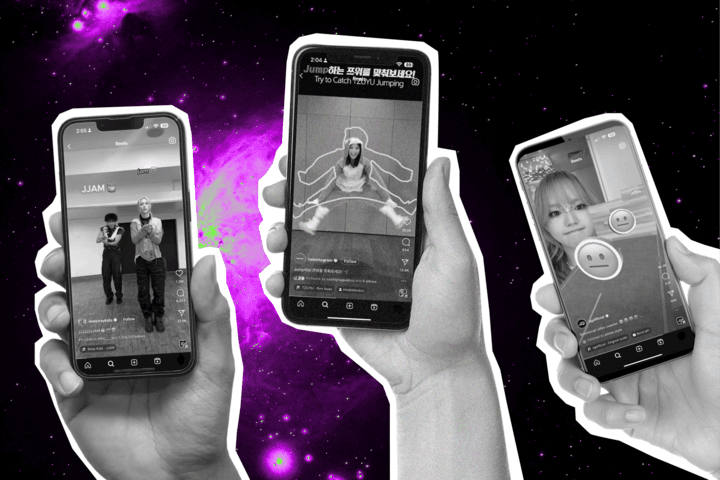
And once the fans are engaged, K-pop groups ensure they stay that way. At a bare minimum, K-pop groups repost high-performing user-generated content. But multinational girl group XG takes it one step further, investing time in stitching videos to react to their fans. Similarly, girl group TWICE’s behind-the-scenes content feels less like traditional marketing and more like intimate FaceTime calls between friends, collapsing the distance between celebrity and fan. Because fans are accustomed to seeing K-pop groups react to their content, they feel seen — and the band’s brand, in turn, becomes more appealing.
Finally — and crucially — K-pop is always global-ready. Since Korean is not spoken as commonly as English, K-pop groups make it a priority to translate their assets so fans can enjoy content they immediately understand. Language is no barrier to fandom when your music videos come equipped with subtitles in a dozen languages: hover over any recent K-pop music video on YouTube and you’ll see them loaded up with captions in Spanish, Italian, French, Chinese, and more. K-pop companies’ effort to make content immediately accessible worldwide is a testament to how much the industry values global reach — and how it lays the groundwork for loyalty right from the start.
Emerline Ji, Director of Strategy
Share Article